
The Fed has said it wants to be "reasonably confident" in the inflation outlook before a rate hike.

Investors' wealth fell by Rs 2.89 lakh crore in two days of market fall, with the BSE Sensex tumbling 796 points on Wednesday, amid weak global market trends ahead of the US Federal Reserve's interest rate decision. Fresh foreign fund outflows and caution ahead of a host of interest rate decisions from global central banks also added to the overall bearish trend. Besides, the US Fed meeting, the BoE (Bank of England) and the BoJ (Bank of Japan) are also scheduled to meet this week.

In a recent note, the global brokerage firm said India now commands a weight of 19 per cent in the above-mentioned portfolio as compared to 18.2 per cent in September 2023. India, it said, is a large liquid market and remains a counter-weight to North Asia if a slowdown in the West occurs and China's recovery disappoints.

Some Manchester United fans had previously urged Musk on Twitter to consider buying the club

'We expect the bull-market phase to still persist, but now led by large-caps which offer better valuation and benefit from FII inflows.'
'We expect continued pressure on midcaps, but any sharp correction looks unlikely from here on.'

The United States survived a fright from little Latvia on Saturday before winning 3-2 in a Fed Cup qualifier as Serena Williams suffered her first career singles loss in the team event. Switzerland, Spain, Belgium, Slovakia, Germany, Russia and Belarus also moved through to the inaugural 12-nation showdown in Budapest.

'The market will focus on the fact that India does have strong earnings growth this year.'
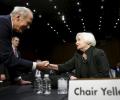
Janet Yellen is guiding the Federal Reserve towards its first rate rise in a decade armed with traditional economic models that some economists worry could fail her in a world of massive money printing and near zero rates.

The mid-and small-cap segments at the bourses have outperformed their larger peers thus far in fiscal 2023-24 (FY24). While the S&P BSE Small-cap index has surged around 5.7 per cent in FY24, the S&P BSE Midcap index has gained 4 per cent during this period. In comparison, the S&P BSE Sensex has moved up around 2.2 per cent.

Among the Sensex firms, NTPC, Mahindra & Mahindra, Power Grid, Nestle, Tata Motors, ITC, Bharti Airtel and Kotak Mahindra Bank were the major gainers. In contrast, Larsen & Toubro, Wipro, JSW Steel, UltraTech Cement, and Asian Paints were among the laggards.

Fed is still concerned about weak export growth.

NITI is trying to partner with other knowledge institutions.

Among the Sensex firms, Infosys, NTPC, Power Grid, Titan, ITC, Tech Mahindra, Hindustan Unilever, Axis Bank, Tata Consultancy Services, Bajaj Finserv, Reliance Industries and UltraTech Cement were the biggest gainers. In contrast, IndusInd Bank, Kotak Mahindra Bank, Mahindra & Mahindra, JSW Steel, HDFC Bank and Maruti were the major laggards.

Investing in the US market provides Indian investors a hedge against the rupee's long-term tendency to depreciate against the dollar.

Investors may take a 5 to 10 per cent exposure to silver. 'Have a long-term investment horizon when investing in silver ETFs to ride out short-term market fluctuations.'

Despite two interest rate cuts from the Fed, concerns about the strength of the economy and the persistence of the credit crunch have so far kept high-yield bonds -- or junk bonds -- under pressure. Look at the closed-end funds, in particular. The gap between the value of the bonds held by these funds -- their net asset values -- and their market price is at historic highs.

Of the eight RBI governors who have held office since the 1991 economic liberalisation, Bimal Jalan had the longest stint and S Venkitaramanan, the shortest. Current Governor Shaktikanta Das will overtake Bimal Jalan before completing his second term in December, points out Tamal Bandyopadhyay.

Bullion may settle with limited upside potential

Market breadth is positive with 942 advances and 196 declines.

Strong currency and sagging oil prices are spooking policymakers.
Glenn Maguire, chief economist (Asia Pacific) at Societe Generale, says that the Fed may raise rates once more, before pausing.\n\n
He adds that it is unlikely to see the Fed rate move above 5.5%.\n\n

The rupee's gains came even as most emerging Asian currencies eased as the yuan fell beyond 6.20 to the dollar for the first time since April last year amid market speculation that the central bank will keep the currency weak as economic growth slows.

'It is the best avenue for investors who would like to take long-term exposure to gold.'

The State Bank of India told the Supreme Court on Thursday it has provided all details of the electoral bonds in its possession to the Election Commission.

The majority in the markets believe that a September lift-off is likely.
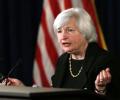
The Fed made clear that the rate hike was a tentative beginning to a "gradual" tightening cycle

Foreign Portfolio Investors' (FPIs) selling spree continues as they pulled out over Rs 3,400 crore from the Indian equity markets in the first three trading sessions of November on rising interest rates and geopolitical tensions in the Middle East. This came after such investors withdrew Rs 24,548 crore in October and Rs 14,767 crore in September, data with the depositories showed. Before the outflow, FPIs were incessantly buying Indian equities in the last six months from March to August and brought in Rs 1.74 lakh crore during the period.

'Returns can be very variable in equity markets.' 'That is why I tell small investors don't put 100 per cent of your money in equities, even if you are young.'

Among the Sensex firms, HDFC Bank emerged as the biggest loser, falling 4 per cent. JSW Steel, Reliance Industries, UltraTech Cement, Maruti, Tata Steel, Wipro, Tech Mahindra, Bharti Airtel and Larsen & Toubro were the other major laggards. Power Grid, Asian Paints, Sun Pharma, Axis Bank, NTPC, ITC and Infosys were among the gainers.

There will very little direct impact from the US Fed's rate hike this time, as we are well prepared both to handle liquidity, outflow of FII funds and managing our currency. But that doesn't mean India will be out of the woods anytime soon, says M V Subramanian.

From the Sensex firms, Bajaj Finance, HDFC, HDFC Bank, Bajaj Finserv, Asian Paint, State Bank of India, Tata Consultancy Services, Bharti Airtel, Reliance Industries and Tata Steel were the biggest gainers. HDFC climbed 2.59 per cent after the housing finance major on Thursday reported a 20 per cent growth in standalone net profit to Rs 4,425 crore for the quarter ending March 2023 on the back of higher interest income. IndusInd Bank, Nestle, Power Grid, ITC, Tata Motors and Mahindra & Mahindra were the major laggards.

Equity markets rallied after softer-than-expected inflation data in the US and UK rekindled hopes of the end of the rate-hiking cycle by major central banks. The soft inflation reading drove down bond yields and the US dollar, whetting the appetite for risky assets. The 10-year US bond yield fell below 4.5 per cent after topping 5 per cent less than a month ago.

Among the Sensex firms, ITC, NTPC, Axis Bank, Larsen & Toubro, Bajaj Finance, Asian Paints and Tata Steel were the major gainers. Mahindra & Mahindra, Wipro, Maruti, IndusInd Bank, Kotak Mahindra Bank and HDFC Bank were among the laggards.
An expected withdrawal of FIIs from the market likely to weaken the rupee against the dollar.

If a 5% to 10% fall in the equity market gives you sleepless nights, you are not cut out for a 75% to 80% allocation to equities and must reduce it.
Further tapering by the US Fed led to a sell-off in emerging markets on concerns of slowdown in foreign fund inflows

Tata Steel, Tech Mahindra, NTPC, JSW Steel, Power Grid, UltraTech Cement, HCL Technologies and HDFC Bank were among the major gainers. Bharti Airtel, Hindustan Unilever, Axis Bank, Reliance Industries, Kotak Mahindra Bank, ICICI Bank and IndusInd Bank were among the laggards.

Summers dogged by controversies over past views

The Indian equity market is likely to remain under pressure and rangebound over the next few months. This comes as global central banks, led by the US Federal Reserve look at a possibility of hiking rates aggressively to tame inflation. Back home, the Reserve Bank of India, too, remains data dependent in its endeavour to keep inflation in check and pursue an aggressive monetary policy stance.
 © 2026 Rediff.com - Advertise with us - Disclaimer - Privacy Policy - Sitemap - Feedback - About us - Terms of use - Grievances